
The Cancer Center at Illinois (CCIL) has more than 130 members from across the Illinois campus. Given the great variety in backgrounds, research disciplines, and experiences of our members, we offer our Q&A series “Get to Know a Cancer Researcher” to provide readers a connection with the amazing array of individuals who comprise the CCIL’s robust cancer research team. This is the eleventh installment.
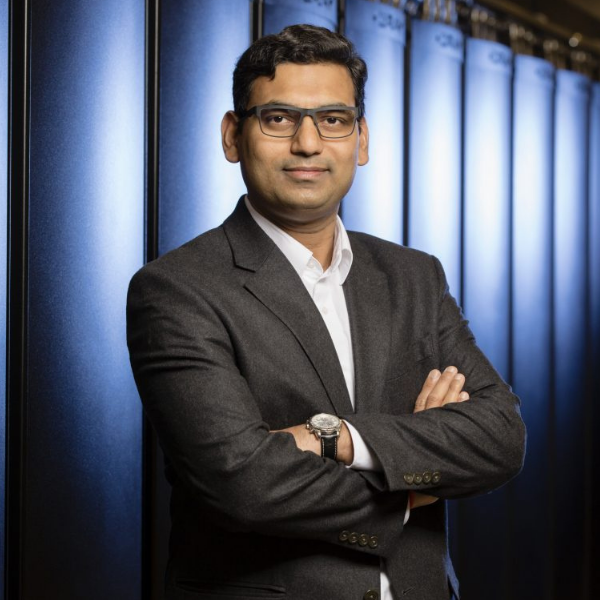
CCIL Member: Diwakar Shukla
CCIL Research Program: Cancer Technology & Data Science
CCIL Research Theme: Computational Engineering and Data Science
Faculty Position: J. W. Westwater Professorial Scholar, Professor of Chemical and Biomolecular Engineering

What originally drew you to cancer research?
As a chemical and biomolecular engineer who works with computers, I’ve always wanted to see how the molecular machines work. I got into cancer research when I realized we could use computer simulations to watch how cancer proteins move and change shape in real time. Traditional lab experiments can miss these fast, structural changes. Using data science and molecular simulations to solve these hidden biological puzzles and knowing it could lead to better treatments made it an easy choice for my work.
What cancer problems are you seeking to address in your lab?
In the Shukla Group, we focus on how cancer proteins respond to drugs. A big problem with cancer treatments is side effects; a drug meant to block a cancer protein might accidentally block a healthy one because they look similar. In our group, we focus on decoding the structural behavior of membrane receptors and signaling proteins to solve the problem of drug selectivity in cancer therapies. We use machine learning and molecular simulations to study selective inhibition across complex systems like cannabinoid receptors (CB1 and CB2) and Smoothened (SMO). By mapping out their activation mechanisms and structural movements, we have uncovered how drugs selectively bind to specific receptor subtypes and how SMO opens an inner tunnel to trigger tumor-driving pathways. We also combine these physics-based models with deep-mutational scanning to engineer growth factor receptors, allowing us to predict how mutations could change drug selectivity.
What keeps you going in your research? How do you recharge?
The best part of the job is the discovery phase. It is incredibly rewarding when a computer model reveals a protein movement or a molecular design that nobody has seen before. To recharge, I step away from the screen and focus on the family. Spending time with my family and just chatting with the students about their life, hobbies and interests helps me clear my mind and return to the work with fresh ideas.
What are fun or quirky facts about you that others may not know?
People usually think my lab only works on problems related to human health, but we actually spend a lot of time studying plants. The same computational approaches and AI models we use to look at cancer proteins also help us understand how plants adapt to their environments. Moving between cancer research and plant science keeps our day-to-day work interesting.
Can you tell us a favorite film or book of yours?
I enjoy books and stories about problem-solving and exploring the unknown. I am always drawn to narratives where people take chaotic, complicated information and find a simple, hidden order within it. The Creative Act: A Way of Being by Rick Rubin aligns perfectly with this theme. While it is written from the perspective of a legendary music producer, its core philosophy mirrors exactly how a scientist approaches research. The book treats creativity not as a magical spark, but as a deliberate practice of tuning in to the world, parsing through noise, and finding hidden structure.
What accomplishment(s) are you most proud of, and why?
I am proud of the research awards and fellowships my students have won. Winning mentoring awards, like the Stanley H. Pierce Award, means a lot to me. Watching students learn to combine ideas from different disciplines, graduate, and go on to start their own scientific careers is the most rewarding part of this work.
What is the best advice you’ve ever received, and how has it shaped your research career?
The best advice I got was to work on the hard problems at the intersection of disciplines. It is easy to stay inside your specific field, like pure engineering or biology. However, the most important breakthroughs happen when you combine different fields. This advice shaped my career by pushing me to build a lab where computer scientists, physicists, chemists, experimental biologists, and engineers work together to solve problems that neither group could solve alone.
Stay tuned for more weekly installments in our “Get to Know a Cancer Researcher” series.
Editor’s notes:
Diwakar Shukla can be reached at diwakar@illinois.edu.
This story was written by Jonathan King, CCIL Communications Coordinator.